
The correct car tyre air pressure is one of the simplest things you can maintain—and one of the easiest to overlook. Whether you drive a compact hatchback through Noida’s city traffic, take an SUV on a highway trip, or own a luxury BMW, Mercedes-Benz or Audi, maintaining the recommended tyre pressure directly affects safety, mileage, tyre life, steering control and driving comfort.
At Resham Tyres, Sector 52, Noida, we regularly see tyres with incorrect air pressure, uneven wear and alignment-related problems that could have been prevented with a simple tyre inspection.
This 2026 guide explains how to maintain the right tyre pressure for different vehicle segments, when to use nitrogen tyre filling, and why wheel alignment and tyre pressure should be checked together.
Why Is Correct Car Tyre Pressure Important?
Your tyres are the only components of your car that continuously remain in contact with the road.
Incorrect tyre pressure can affect:
- Fuel efficiency
- Braking performance
- Steering response
- Cornering stability
- Tyre tread life
- Ride comfort
- Highway safety
- Suspension performance
A tyre that is under-inflated can create excessive rolling resistance, while over-inflation can reduce the tyre’s contact area with the road.
The goal is not to use the highest possible pressure—it is to maintain the vehicle manufacturer’s recommended tyre pressure.
What Is the Correct Tyre Pressure for a Car?
There is no single tyre pressure that is correct for every vehicle.
The recommended pressure depends on:
- Vehicle model
- Tyre size
- Vehicle weight
- Front/rear axle load
- Number of passengers
- Luggage load
- Driving conditions
For most cars, the manufacturer’s recommended tyre pressure can be found on a sticker located on the driver-side door frame, B-pillar, fuel-filler flap or inside the owner’s manual.
Always follow the vehicle manufacturer’s specification rather than relying on a generic PSI number.
Car Tyre Pressure by Vehicle Segment
1. Hatchback Tyre Pressure
Hatchbacks such as:
- Maruti Swift
- Maruti Baleno
- Maruti Wagon R
- Hyundai Grand i10 Nios
- Hyundai i20
- Tata Tiago
- Tata Altroz
generally use relatively smaller tyre sizes and have lower overall vehicle weight compared with SUVs.
For hatchbacks, maintaining the recommended pressure is particularly important for city mileage and comfortable driving.
Common problems caused by incorrect pressure:
- Reduced mileage
- Uneven tread wear
- Heavy steering
- Poor braking response
- Increased tyre temperature
Tip: Check hatchback tyre pressure at least once every 2–4 weeks, and before long highway journeys.
2. Sedan Tyre Pressure
Popular sedans include:
- Honda City
- Hyundai Verna
- Volkswagen Virtus
- Skoda Slavia
- Maruti Ciaz
- Hyundai Aura
Sedans are often driven both in city traffic and on highways, making correct tyre pressure essential for a balance between comfort, stability and fuel economy.
Before a highway trip, inspect all four tyres and the spare tyre.
If the car is carrying several passengers and luggage, follow the manufacturer’s full-load tyre-pressure recommendation where provided.
3. SUV & Compact SUV Tyre Pressure
SUVs such as:
- Hyundai Creta
- Kia Seltos
- Tata Nexon
- Mahindra XUV700
- Toyota Fortuner
- MG Hector
- Jeep Compass
have different tyre sizes, weights and suspension configurations.
SUV owners should pay particular attention to tyre pressure because incorrect inflation can affect:
- High-speed stability
- Cornering
- Steering response
- Tyre shoulder wear
- Fuel efficiency
City vs Highway SUV Driving
Don’t automatically increase tyre pressure simply because you’re driving on a highway.
Instead, follow the manufacturer’s recommended pressure, including any specified full-load setting.
4. Luxury Car Tyre Pressure
Luxury and performance vehicles require additional attention because many use:
- Low-profile tyres
- Large alloy wheels
- Run-flat tyres
- Performance-oriented suspension
- Advanced electronic safety systems
Examples include:
- BMW
- Mercedes-Benz
- Audi
- Jaguar
- Volvo
- Land Rover
- Lexus
- Porsche
Even a small pressure deviation can noticeably change steering feel and ride comfort.
For premium cars, tyre pressure should be checked regularly using a reliable pressure gauge.
Cold Tyre Pressure vs Hot Tyre Pressure
One of the most important tyre-pressure rules is:
Check tyre pressure when tyres are cold.
Driving generates heat inside the tyre, causing air pressure to temporarily increase.
Therefore, checking pressure immediately after a long drive may give a higher reading than the actual cold pressure.
Best time: Before driving or after the vehicle has been parked for several hours.
What Happens When Tyre Pressure Is Too Low?
Under-inflated tyres can cause:
Increased Rolling Resistance
The engine needs more energy to move the vehicle.
Reduced Mileage
Higher rolling resistance can negatively affect fuel economy.
Excessive Heat
Low pressure increases tyre flexing and heat generation.
Shoulder Wear
The outer edges of the tread may wear faster.
Poor Handling
Steering can feel heavier and less responsive.
Increased Risk of Tyre Damage
The sidewall can flex excessively when driving over potholes.
What Happens When Tyre Pressure Is Too High?
Over-inflation can also create problems.
Potential effects include:
- Reduced road contact
- Harsher ride
- Reduced grip
- Faster centre tread wear
- Less comfortable driving
- Changed handling characteristics
Therefore, more air does not mean better tyre performance.
Does Tyre Pressure Affect Mileage?
Yes.
Incorrect tyre pressure can increase rolling resistance and affect fuel consumption.
However, tyre pressure is only one factor influencing mileage. Driving style, traffic, vehicle condition, tyre type, wheel alignment and load also matter.
This is why maintaining correct tyre pressure should be part of your overall tyre-maintenance routine.
Tyre Pressure and Wheel Alignment: Why Both Matter
Many car owners check air pressure but ignore wheel alignment.
These are two different things.
Tyre Pressure
Controls how much air is inside the tyre and affects:
- Contact patch
- Rolling resistance
- Comfort
- Tyre temperature
Wheel Alignment
Ensures that the wheels are positioned according to the vehicle manufacturer’s suspension geometry.
Alignment primarily involves:
- Camber
- Caster
- Toe
A car can have perfectly inflated tyres but still have incorrect wheel alignment.
Signs You May Need Wheel Alignment
Visit a professional wheel alignment service if you notice:
- Steering wheel is off-centre
- Car pulls left or right
- Uneven tyre wear
- Feathering on tyre tread
- Steering instability
- Vehicle feels difficult to keep straight
- Tyres squeal during turns
At Resham Tyres, Sector 52 Noida, computerized wheel alignment helps identify alignment deviations and allows technicians to make the necessary adjustments.
Recommended Search Terms
If you’re searching online for the service, you may find it listed as:
Wheel Alignment in Noida | Computerized Wheel Alignment | 3D Wheel Alignment | Hunter Wheel Alignment | Car Wheel Alignment Near Me | SUV Wheel Alignment Noida | Luxury Car Wheel Alignment Noida
Nitrogen vs Normal Air for Car Tyres
Another common question is whether drivers should use nitrogen instead of regular compressed air.
Nitrogen tyre filling can be considered as part of a tyre-maintenance routine.
Potential advantages of nitrogen:
- More stable pressure behaviour
- Reduced moisture content compared with ordinary compressed air
- Useful for drivers who want consistent tyre-pressure maintenance
- Particularly popular for premium and performance vehicles
However, nitrogen is not a replacement for checking tyre pressure regularly.
If nitrogen-filled tyres lose pressure, they still need to be checked and topped up.
Is Nitrogen Filling Necessary for Every Car?
No.
A properly maintained tyre filled with normal compressed air can perform safely when the correct pressure is maintained.
Nitrogen can be a useful option, but correct pressure matters more than whether the tyre contains nitrogen or regular air.
At Resham Tyres, customers looking for nitrogen tyre filling in Noida can get their tyre pressure checked as part of regular tyre maintenance.
How Often Should You Check Car Tyre Pressure?
A practical routine is:
Every 2–4 weeks: Check tyre pressure.
Before a highway trip: Check all tyres and the spare.
After hitting a major pothole: Inspect tyres and consider alignment checking.
After installing new tyres: Check pressure and wheel alignment.
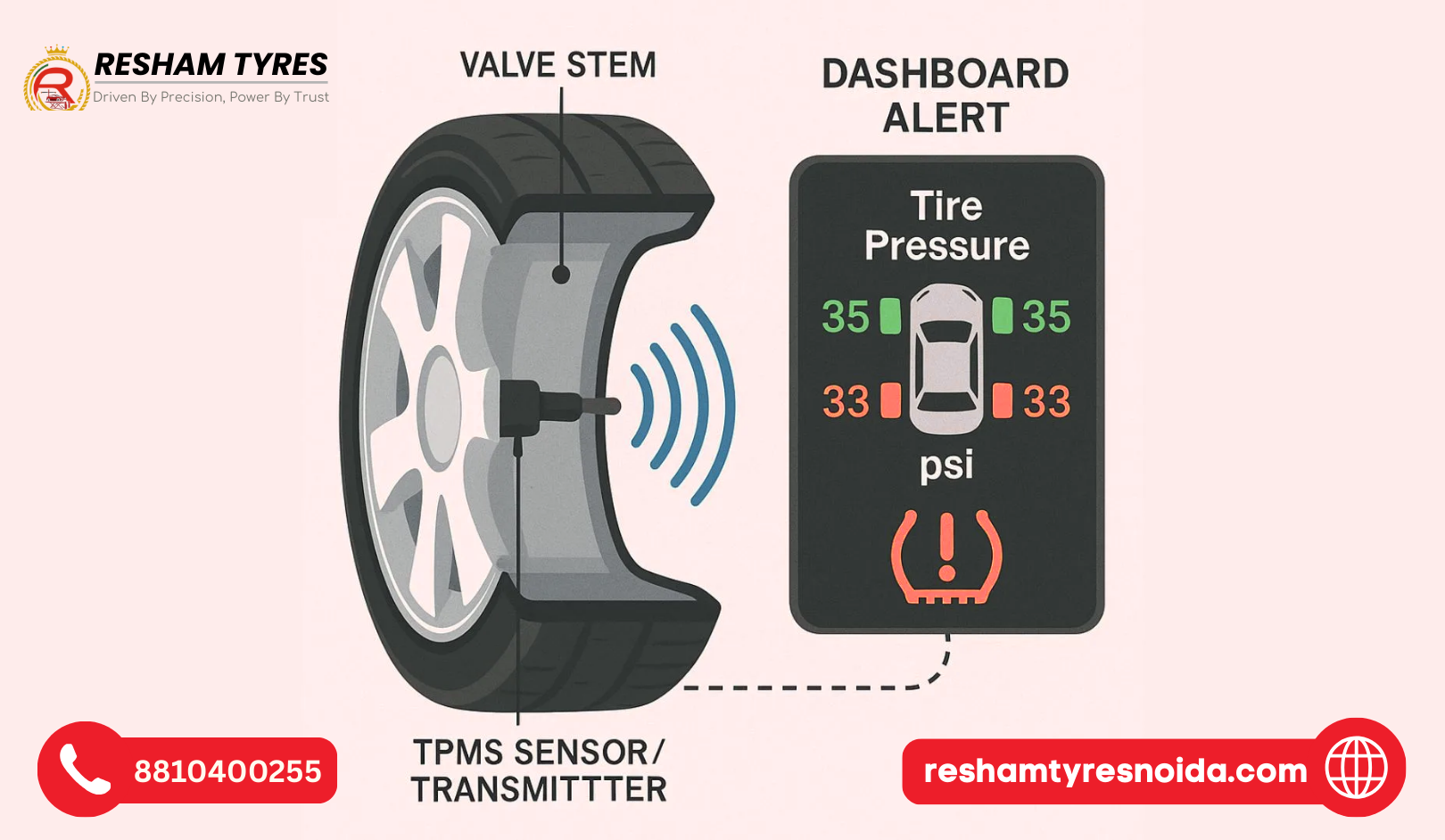
When the TPMS warning appears: Inspect pressure immediately.
Tyre Pressure, Alignment & Balancing: The Complete Connection
For the best tyre performance, these three areas should not be considered separately.
1. Correct Tyre Pressure
Maintains the correct tyre contact and rolling characteristics.
2. Wheel Alignment
Keeps the wheels correctly positioned relative to the road and suspension.
3. Wheel Balancing
Corrects uneven weight distribution around the wheel and tyre assembly.
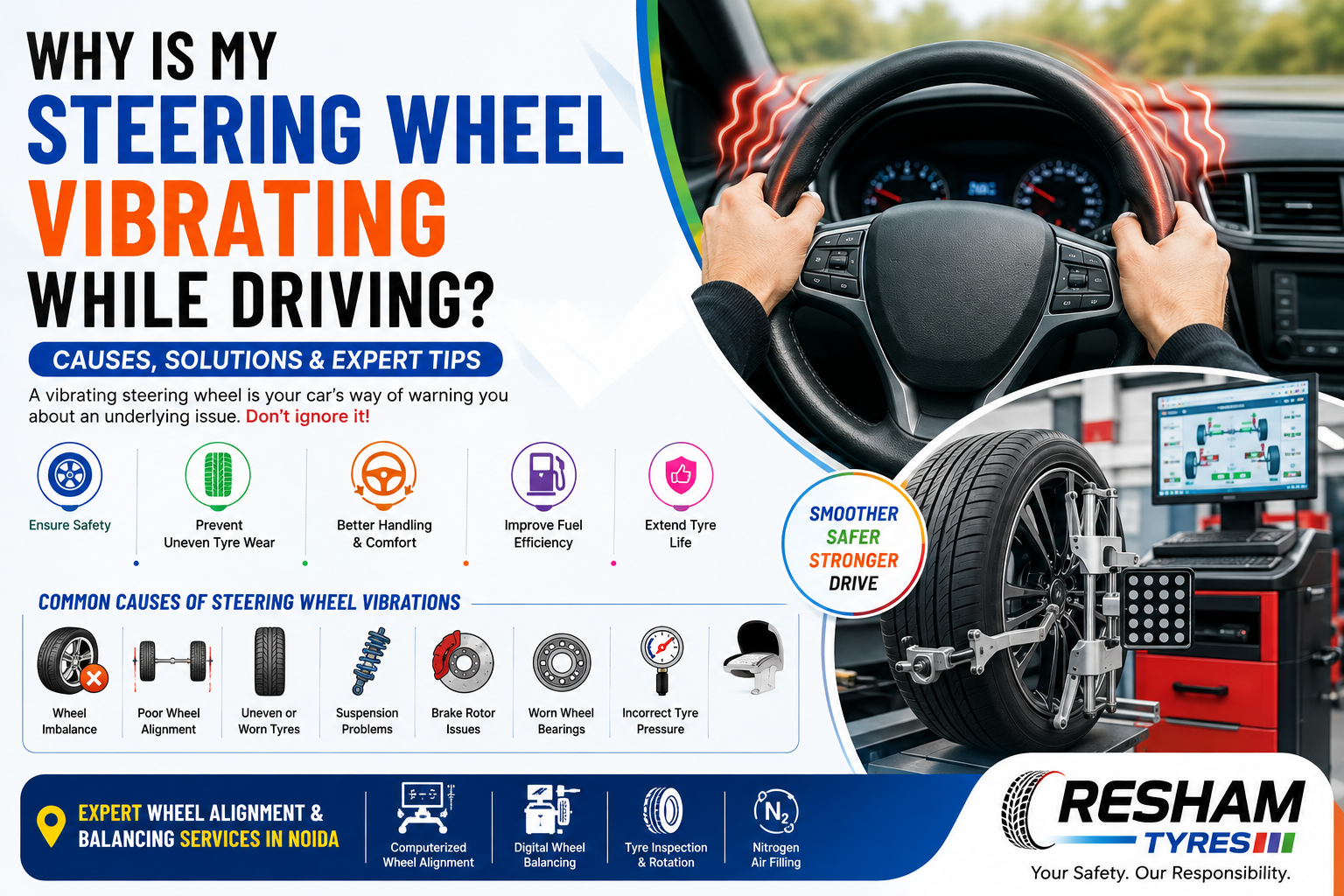
If your steering wheel vibrates, your car pulls to one side or your tyres are wearing unevenly, a professional inspection can determine whether the issue is related to tyre pressure, wheel balancing, wheel alignment or suspension components.
7 Tyre Pressure Mistakes Car Owners Should Avoid
1. Using a random PSI number
Always follow the manufacturer’s recommendation.
2. Checking pressure only when tyres look flat
A tyre can be significantly under-inflated without looking obviously flat.
3. Checking immediately after driving
Hot tyres can give a temporarily higher pressure reading.
4. Ignoring the spare tyre
Your spare can lose pressure even when it isn’t being used.
5. Forgetting about full-load settings
Check your vehicle’s recommended pressure for passenger and luggage loads.
6. Ignoring uneven tyre wear
It may indicate alignment, pressure or suspension issues.
7. Assuming nitrogen means no maintenance
Nitrogen-filled tyres still require regular pressure checks.
Expert Tyre Care Tips from Resham Tyres
For better tyre performance and longer tread life:
✔ Check tyre pressure regularly.
✔ Follow the vehicle manufacturer’s recommended PSI.
✔ Check pressure before long highway journeys.
✔ Inspect tyres for cuts, cracks and bulges.
✔ Get wheel alignment checked after major pothole impacts.
✔ Balance wheels when vibration occurs.
✔ Rotate tyres according to the vehicle manufacturer’s recommendation.
✔ Check the spare tyre.
✔ Don’t ignore TPMS warnings.
✔ Replace tyres when tread or condition indicates they are no longer safe.
When Should You Visit a Tyre Shop?
Don’t wait until a tyre becomes visibly damaged.
Visit a professional tyre shop if you experience:
Pressure loss → Check for puncture or valve leakage.
Uneven wear → Check wheel alignment and suspension.
Steering vibration → Check wheel balancing and tyre condition.
Car pulling → Check alignment and tyre pressure.
Repeated pressure loss → Inspect tyre, valve and wheel for leakage.
New tyres → Check recommended pressure and wheel alignment.
Why Choose Resham Tyres in Noida?
Resham Tyres, Sector 52, Noida provides comprehensive tyre-care services for everyday cars, SUVs and premium vehicles.
Our services include:
- Car Tyre Sales
- Premium Tyres
- SUV Tyres
- Luxury Car Tyres
- Tyre Pressure Check
- Nitrogen Tyre Filling
- Wheel Alignment
- Computerized Wheel Alignment
- Hunter Wheel Alignment
- Wheel Balancing
- Tyre Rotation
- Puncture & Tyre Inspection
Whether you’re searching for tyre pressure check near me, nitrogen filling in Noida, wheel alignment in Noida, wheel balancing near me, or a reliable tyre shop in Sector 52 Noida, Resham Tyres can help you maintain your vehicle’s tyres correctly.
Final Word: Correct Pressure Is the First Step to Better Tyre Performance
Your car doesn’t need complicated maintenance to get better tyre performance. Start with something simple: maintain the correct tyre pressure.
But don’t stop there.
For complete tyre care, combine regular pressure checks with wheel alignment, wheel balancing, tyre rotation and professional tyre inspections.
From hatchbacks and sedans to SUVs and luxury cars, the right tyre-maintenance routine can improve safety, comfort, handling and tyre longevity.
Looking for tyre pressure check, nitrogen tyre filling or wheel alignment in Noida?
Visit Resham Tyres, Sector 52, Noida or contact the team for professional tyre-care assistance.
Resham Tyres – Your Trusted Tyre & Wheel Care Partner in Noida
WhatsApp: 88104 00255
Website: reshamtyresnoida.com
FAQs
What is the correct air pressure for car tyres?
The correct pressure varies by vehicle and tyre specification. Check the manufacturer’s tyre-pressure sticker or owner’s manual rather than using a generic PSI recommendation.
How often should I check my car tyre pressure?
Checking every 2–4 weeks and before long journeys is a practical routine. Always check sooner if you notice pressure loss or a TPMS warning.
Is nitrogen better than normal air for car tyres?
Nitrogen can offer some pressure-stability and moisture-related benefits, but regular pressure checks remain essential. Correct tyre pressure is more important than the type of inflation gas.
Does wheel alignment affect tyre pressure?
Wheel alignment and tyre pressure are separate maintenance factors, but both affect tyre wear, handling and overall tyre performance. Incorrect alignment can cause uneven tyre wear even when pressure is correct.
Does wheel alignment improve tyre life?
Yes. Correct wheel alignment helps prevent abnormal and uneven tread wear, potentially extending usable tyre life.
Should tyre pressure be increased before highway driving?
Not automatically. Use the vehicle manufacturer’s recommended setting. If your vehicle provides a different recommended pressure for a fully loaded car, follow that specification.
Where can I get nitrogen tyre filling in Noida?
Resham Tyres in Sector 52, Noida provides tyre-care services including nitrogen tyre filling, tyre pressure checks, wheel alignment and wheel balancing.
Where can I get wheel alignment in Noida?
Resham Tyres, Sector 52, Noida offers computerized wheel alignment services for hatchbacks, sedans, SUVs and premium/luxury vehicles.