
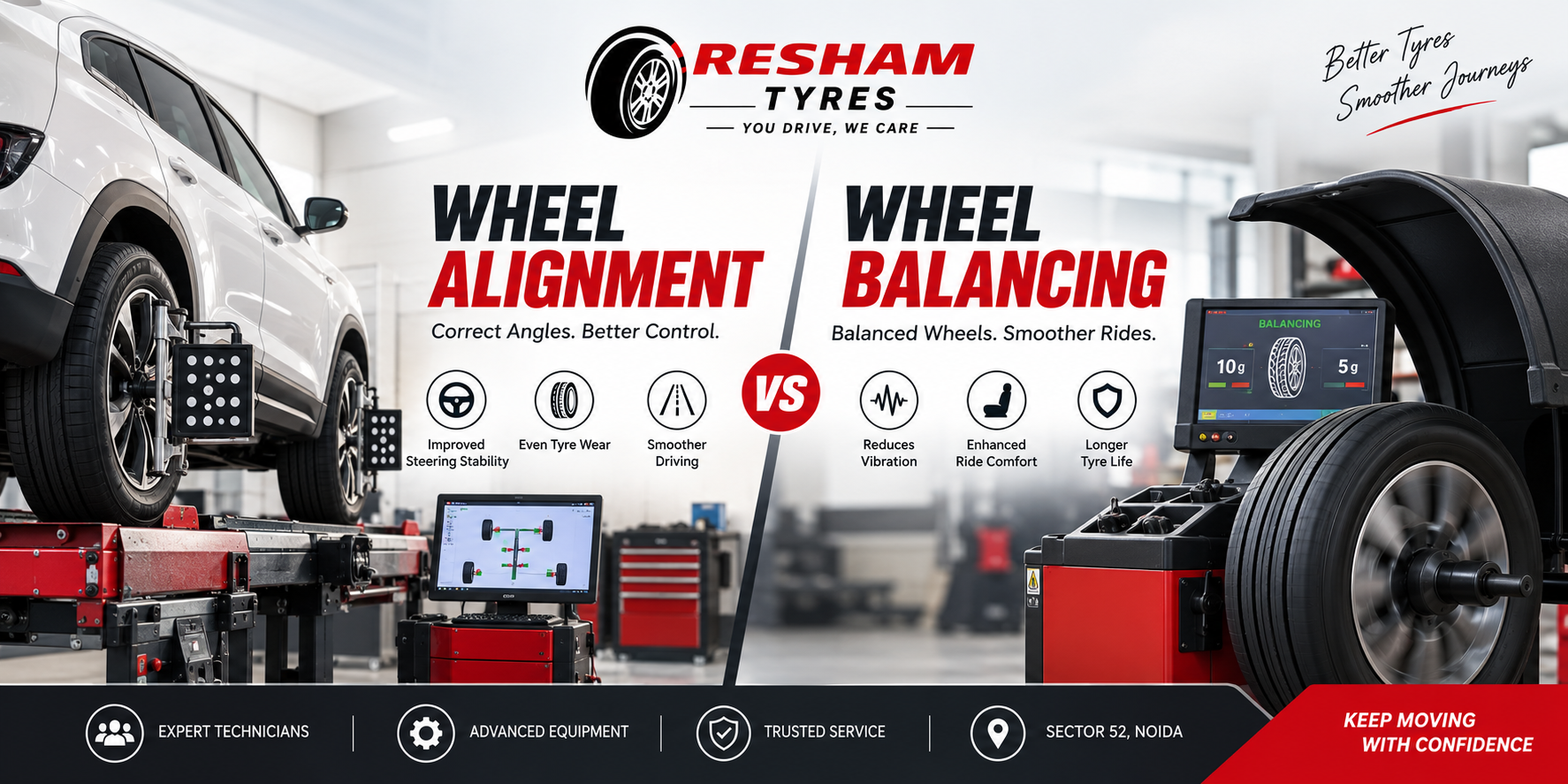
Have you ever wondered whether your car needs wheel alignment or wheel balancing? Both services are important for tyre maintenance, but they solve different problems.
Wheel alignment corrects the angles of your vehicle’s wheels and suspension, while wheel balancing corrects uneven weight distribution in a wheel-and-tyre assembly. Alignment mainly affects steering geometry and tyre wear; balancing mainly addresses vibration and smoothness.
Understanding the difference can help you choose the right service, avoid unnecessary expenses, and maintain better tyre performance.
At Resham Tyres, Sector 52, Noida, we provide professional tyre and wheel care services, including wheel alignment and wheel balancing, for hatchbacks, sedans, SUVs, and premium vehicles.
Wheel Alignment vs Wheel Balancing: Quick Answer
| Feature | Wheel Alignment | Wheel Balancing |
|---|---|---|
| What it corrects | Wheel and suspension angles | Uneven weight distribution |
| Main purpose | Correct steering geometry and tyre contact | Reduce vibration and improve ride smoothness |
| Common symptom | Car pulls to one side or steering wheel is off-center | Steering wheel or vehicle vibrates at certain speeds |
| Effect on tyres | Helps prevent uneven tread wear | Helps reduce vibration-related stress and irregular wear |
| Equipment used | Computerized alignment machine | Wheel balancing machine |
| When required | After impacts, suspension work, or alignment symptoms | After tyre installation, wheel removal, or vibration |
| Can one replace the other? | No | No |
In simple words: If your car is pulling to one side, alignment may be the issue. If your steering wheel is vibrating at certain speeds, balancing may be needed. However, a proper inspection is necessary because similar symptoms can have multiple causes.
What Is Wheel Alignment?
Wheel alignment is the process of measuring and adjusting the angles of a vehicle’s wheels and suspension according to the manufacturer’s recommended specifications.
These angles determine how the tyres contact the road and how the vehicle responds to steering inputs.
When alignment is incorrect, the tyres may not remain properly positioned relative to the road. This can lead to uneven tread wear, steering issues, and reduced driving stability.
The Three Main Wheel Alignment Angles
1. Camber
Camber is the inward or outward tilt of a wheel when viewed from the front of the vehicle.
- Positive camber: The top of the wheel tilts outward.
- Negative camber: The top of the wheel tilts inward.
Incorrect camber can cause excessive wear on the inner or outer edge of the tyre.
2. Caster
Caster is the angle of the steering axis when viewed from the side.
It contributes to:
- Steering stability
- Straight-line control
- Steering wheel return after a turn
Caster adjustment availability depends on the vehicle’s suspension design.
3. Toe
Toe describes whether the front edges of the tyres point inward or outward when viewed from above.
- Toe-in: Front edges point slightly inward.
- Toe-out: Front edges point slightly outward.
Incorrect toe settings can cause feathering and rapid, uneven tyre wear.
What Is Wheel Balancing?
Wheel balancing is the process of correcting uneven weight distribution in a wheel-and-tyre assembly.
Even when a tyre and wheel appear perfectly round, their weight may not be distributed equally around the rotation axis. This imbalance can create vibration when the wheel spins.
During balancing, the wheel-and-tyre assembly is mounted on a balancing machine. The machine identifies the imbalance, and the technician adds or adjusts small balancing weights to help distribute the weight more evenly.
What Does Wheel Balancing Improve?
Proper wheel balancing helps:
- Reduce steering wheel vibration
- Improve ride smoothness
- Reduce vibration through the vehicle
- Support even tyre rotation
- Minimize unnecessary stress on wheel and suspension components
Important: Wheel balancing does not correct suspension angles. It is a different service from wheel alignment.
Wheel Alignment vs Wheel Balancing: Main Differences Explained
1. Difference in Purpose
Wheel alignment focuses on the relationship between the wheels, steering system, and suspension geometry.
Wheel balancing focuses on the weight distribution of the rotating wheel-and-tyre assembly.
Both affect driving comfort and tyre performance, but they address different mechanical conditions.
2. Difference in Symptoms
| Wheel Alignment Symptoms | Wheel Balancing Symptoms |
|---|---|
| Car pulls left or right | Steering wheel vibrates |
| Steering wheel remains off-center | Vibration appears at certain speeds |
| Uneven inner or outer tyre wear | Vibration may increase with speed |
| Feathered tyre tread | Uneven rotation feel |
| Vehicle requires frequent steering correction | Vibration may be felt through seats or floor |
These symptoms are indicators, not definitive diagnoses. Tyre pressure, suspension wear, damaged tyres, wheel damage, and road conditions can also produce similar problems.
3. Difference in Equipment
Wheel Alignment Machine
An alignment machine measures wheel angles such as camber, caster, and toe. Modern computerized systems display measurements and help technicians identify deviations from recommended specifications.
Wheel Balancing Machine
A balancing machine spins the wheel-and-tyre assembly and identifies where weight correction may be required.
4. Difference in Maintenance Timing
Wheel alignment is commonly checked after:
- Hitting a pothole or curb
- Suspension or steering repairs
- Major road impacts
- Uneven tyre wear
- Steering-related symptoms
Wheel balancing is commonly performed after:
- Installing new tyres
- Removing and refitting tyres
- Repairing a puncture that requires tyre removal
- Noticing vibration at speed
- Replacing or repairing a wheel
Signs Your Car Needs Wheel Alignment
1. The Car Pulls to One Side
If your vehicle consistently drifts left or right on a reasonably straight road, it may indicate an alignment issue.
However, tyre pressure differences and road slope should also be checked.
2. Steering Wheel Is Not Centered
If the steering wheel remains tilted while the car is travelling straight, the steering geometry may need inspection.
3. Uneven Tyre Wear
Look for:
- Inner-edge wear
- Outer-edge wear
- Feathering
- One tyre wearing faster than the others
Alignment is one possible cause, but tyre pressure, suspension condition, and tyre rotation history also matter.
4. Steering Requires Frequent Correction
A vehicle that feels difficult to keep straight may need an alignment inspection.
5. Tyres Squeal During Normal Turns
Unusual squealing can sometimes be associated with incorrect alignment, although tyre condition, road surface, and driving style can also contribute.
Signs Your Car Needs Wheel Balancing
1. Steering Wheel Vibration
A common sign of wheel imbalance is vibration felt through the steering wheel, particularly at certain speeds.
2. Vibration Increases with Speed
If vibration becomes more noticeable as speed increases, wheel balancing should be checked.
3. Vibration Through the Seat or Floor
Depending on the wheel position and vehicle design, imbalance may be felt through the seat, floor, or body of the vehicle.
4. Uneven Tyre Wear
Imbalance can contribute to irregular wear patterns, although alignment, suspension, and tyre pressure should also be inspected.
5. Vibration After New Tyre Installation
If vibration begins after fitting new tyres, the wheel-and-tyre assembly should be checked for balancing, mounting, and other installation-related issues.
What Causes Wheel Misalignment?
Common causes include:
- Hitting potholes
- Driving over curbs
- Speed-breaker impacts
- Minor accidents
- Suspension repairs
- Steering component replacement
- Worn suspension bushes or joints
- Long-term driving on uneven roads
Noida’s traffic conditions, road impacts, and frequent speed breakers can make regular tyre and wheel inspections useful.
What Causes Wheel Imbalance?
Wheel imbalance may result from:
- Uneven tyre weight distribution
- Uneven wheel weight distribution
- Incorrectly fitted balancing weights
- Loss of balancing weights
- Tyre replacement
- Wheel or tyre damage
- Improper tyre mounting
A balancing machine helps identify the location and amount of correction required.
Wheel Alignment vs Wheel Balancing: Which One Do You Need?
Use the following guide as a starting point:
| Your Problem | Service to Check |
|---|---|
| Car pulls left or right | Wheel alignment |
| Steering wheel is off-center | Wheel alignment |
| Inner or outer tyre wears faster | Wheel alignment inspection |
| Steering wheel vibrates at speed | Wheel balancing |
| Vibration after new tyres | Wheel balancing |
| Vehicle feels unstable after pothole impact | Alignment + suspension inspection |
| New tyres installed | Balancing + alignment check |
| Suspension parts replaced | Wheel alignment |
Important: Sometimes a vehicle needs both alignment and balancing. For example, after installing new tyres, balancing may be required to correct weight distribution, while alignment may be checked to ensure the wheel angles are correct.
Can Wheel Alignment and Wheel Balancing Be Done Together?
Yes. These services can be performed during the same visit when the vehicle’s condition requires both.
A common maintenance sequence is:
- Inspect tyres and suspension.
- Check tyre pressure.
- Perform wheel balancing if required.
- Check and adjust wheel alignment where necessary.
- Conduct a final inspection.
The exact order may vary depending on the vehicle and the technician’s diagnostic process.
Wheel Alignment and Wheel Balancing Cost in Noida
The cost depends on the vehicle category, service type, equipment, and any additional repair requirements.
The following are indicative medium-range prices for standard services, not fixed quotations.
| Service | Car Category | Indicative Price |
|---|---|---|
| Wheel Alignment | Hatchback / Small Car | ₹600–₹800 |
| Wheel Alignment | Sedan | ₹700–₹1,000 |
| Wheel Alignment | SUV | ₹800–₹1,300 |
| Wheel Alignment | Luxury / Premium Car | ₹1,500–₹2,500+ |
| Wheel Balancing | Hatchback / Small Car | ₹400–₹700 |
| Wheel Balancing | Sedan | ₹500–₹800 |
| Wheel Balancing | SUV | ₹600–₹1,000 |
| Wheel Balancing | Luxury / Premium Car | ₹800–₹1,500+ |
Note: Actual prices may vary according to the vehicle model, number of wheels serviced, tyre size, equipment used, and any additional work required. Contact Resham Tyres for the current price of your vehicle.
How Often Should Wheel Alignment Be Done?
There is no universal interval that applies to every vehicle.
It is advisable to get alignment checked:
- After a major pothole or curb impact
- After suspension or steering repairs
- When replacing tyres
- When the steering wheel is off-center
- When the vehicle pulls to one side
- When uneven tyre wear is noticed
- Before a long highway trip
- During periodic tyre maintenance
Many vehicle owners choose to check alignment approximately every 8,000–10,000 km, but the ideal interval depends on driving conditions, vehicle usage, and manufacturer recommendations.
How Often Should Wheel Balancing Be Done?
Wheel balancing should be checked when:
- New tyres are installed
- A tyre is removed and refitted
- A puncture repair requires tyre removal
- Steering or vehicle vibration develops
- Balancing weights are lost
- A wheel or tyre is repaired
- Irregular vibration is noticed at speed
Routine balancing intervals vary by vehicle usage and tyre condition. A technician can recommend the appropriate inspection based on symptoms and maintenance history.
Does Wheel Alignment Improve Fuel Efficiency?
Correct wheel alignment can help reduce unnecessary tyre scrubbing and rolling resistance. This may support better fuel efficiency.
However, fuel economy also depends on:
- Tyre pressure
- Driving habits
- Traffic conditions
- Vehicle load
- Engine condition
- Tyre design
- Road surface
Wheel alignment should not be treated as a guaranteed mileage-improvement solution.
Can Wheel Balancing Improve Fuel Efficiency?
Proper wheel balancing helps reduce vibration and supports smoother wheel rotation.
It is primarily a ride comfort and wheel-performance service, rather than a direct fuel-saving treatment. Any fuel-efficiency effect is generally secondary and depends on the vehicle’s overall condition.
Does Wheel Alignment Fix Steering Vibration?
Not always.
Steering vibration is commonly associated with wheel imbalance, but it can also result from:
- Tyre damage
- Bent wheels
- Suspension problems
- Worn steering components
- Brake-related issues
- Incorrect tyre pressure
A proper inspection is necessary before deciding whether alignment, balancing, or another repair is required.
Why Choose Resham Tyres for Alignment & Balancing in Noida?
At Resham Tyres, Sector 52, Noida, we focus on professional tyre and wheel care for different vehicle categories.
Our services include:
- Computerized wheel alignment
- Wheel balancing
- Tyre inspection
- Car tyre replacement
- SUV tyre services
- Premium and luxury car tyre services
- Tyre pressure checks
- Tyre rotation and maintenance guidance
Our technicians inspect the vehicle’s symptoms and recommend the relevant service rather than assuming every problem requires alignment or balancing.
Expert Tips for Better Tyre Life
Follow these practical maintenance tips:
- Check tyre pressure regularly according to the vehicle manufacturer’s recommendation.
- Inspect tyres for uneven wear at least once a month.
- Get balancing checked after tyre installation or when vibration develops.
- Check alignment after pothole impacts or suspension repairs.
- Rotate tyres according to the vehicle manufacturer’s recommendations.
- Avoid driving with damaged or severely worn tyres.
- Inspect suspension components if alignment problems return frequently.
- Use the correct tyre size and load rating for your vehicle.
- Do not ignore steering vibration that persists or worsens.
- Choose a service centre with suitable equipment and trained technicians.
Frequently Asked Questions
What is the main difference between wheel alignment and wheel balancing?
Wheel alignment corrects the angles of the wheels and suspension, while wheel balancing corrects uneven weight distribution in the wheel-and-tyre assembly.
Which is more important: wheel alignment or balancing?
Neither service replaces the other. The correct service depends on the vehicle’s symptoms and inspection results.
Can I drive with bad wheel alignment?
You may be able to drive, but incorrect alignment can contribute to uneven tyre wear, steering issues, and reduced handling stability. It is advisable to have the vehicle inspected.
Can I drive with unbalanced wheels?
Unbalanced wheels can cause vibration and may contribute to uneven wear. Persistent vibration should be checked promptly.
Is wheel balancing required after changing tyres?
Yes, wheel balancing is generally recommended after installing new tyres because the wheel-and-tyre assembly may require weight correction.
Is wheel alignment required after changing tyres?
An alignment check is advisable, especially if the previous tyres had uneven wear or the vehicle shows steering-related symptoms.
Does wheel alignment include wheel balancing?
No. Wheel alignment and wheel balancing are separate services and may be charged separately.
How long does wheel alignment take?
A standard alignment service may take approximately 30–60 minutes, depending on the vehicle and whether additional inspection or adjustment is required.
How long does wheel balancing take?
Standard wheel balancing may take approximately 30–60 minutes, depending on the number of wheels, tyre condition, and any additional work required.
What should I do if my car pulls to one side and vibrates?
Both alignment and balancing should be checked, along with tyre pressure, tyre condition, suspension, and steering components. The symptoms alone cannot confirm one specific cause.
Where can I get wheel alignment and balancing in Noida?
You can visit Resham Tyres, Sector 52, Noida, for professional wheel alignment, wheel balancing, and tyre care services. Contact the service centre to confirm availability and pricing for your vehicle.
Final Thoughts
Wheel alignment and wheel balancing are two essential but different aspects of car maintenance.
Alignment helps keep your wheels correctly positioned, while balancing helps keep the wheel-and-tyre assembly rotating smoothly. Recognizing the difference can help you identify symptoms earlier, reduce unnecessary tyre wear, and maintain better driving comfort.
If your car is pulling to one side, the steering wheel is off-center, or you notice vibration at speed, a professional inspection can help determine whether alignment, balancing, or another repair is required.
For professional wheel alignment and wheel balancing in Noida, visit Resham Tyres, Sector 52, and get your vehicle checked by experienced technicians.
Contact Resham Tyres
📍 Location: Resham Tyres, Sector 52, Noida 📞 WhatsApp: 88104 00255 🌐 Website: reshamtyresnoida.com